The Wolf and The Unicorn

In Sagenlund, stories matter. They are more than entertainment and history, and at times more than prophecy. They are forces that quietly reshape the world. Most tales are small things: comforts for children, warnings whispered at night, half-remembered lessons passed from one generation to the next. But every so often, a story takes hold strongly enough that it does more than endure. It changes what is possible.

The following tale is one such story. It is the first telling of the Wolf and the Unicorn, a myth that spread faster than it could be contained and, in doing so, gave rise to Overmodmarken—the unexplored continent over which the King and the Bard now vie through stories. Whether told as a children’s story, a migration myth, or a quiet act of defiance, it stands at the heart of Sagenlund’s lore, marking the moment when hope was no longer something remembered, but something to be pursued.

What followed were the myths that gave rise to the heroes – the hope-bringers. Then came monsters, despair, and everything that devourers hope. I will follow up with entries for those as well, but today I share the foundation myth that led to a vast new continent, filled with dangerous legends, powerful treasures, and myths yet to be told.

The Wolf and The Unicorn:

Long ago, there were two children. During the great war, their father was called into service. On the last night he was home, he told them the story of the wolf and the unicorn.

As he went to tuck them in for bed, the little one began to cry. The sound of his tears broke the older one’s spirit, and soon both children were sobbing uncontrollably. They wondered if they would ever see their father again.

The father held them each in turn, then asked if they had heard the story of the Wolf and the Unicorn. They shook their heads, trying to stop the flow of tears. Then the father began:

Two children went into the woods to play.

They played and played, making forts, pretending they were knights, and all manner of make-believe. Before long, they had become hopelessly lost. They tried to find their way out and came across a small squirrel. They asked the squirrel for help. He replied, “Out of the forest? How could that be? The forest goes on forever.”

Next, they found a bird and asked the same question. The bird replied, “Out of the forest? Why, you need only go up.”

They continued on like this, and each animal in turn shared its own way out—the turtle telling them to go into the river, the mouse telling them to go underground, and so on.

Then they came upon a wolf and a unicorn. Like all the other animals, they offered a way out. The wolf promising food and shelter, the unicorn simply showing them the way.

Their stomachs growled, and they followed the wolf. As they walked, they asked how much further they were, and each time the wolf replied, “Not far.” The brother began to grow nervous, and each time he glanced around, he caught a glimpse of the unicorn.

Finally, they neared their destination. The wolf nodded them toward a cave, and his smile revealed sharp teeth stained a brilliant crimson. The boy nudged his sister and pointed through the trees, where light reflected brilliantly off a shining horn.

Something in them broke all at once. The sister seized her brother’s hand and ran.

With this, the wolf grew angry and gave pursuit. Ahead, the children glimpsed light flashing from the unicorn’s horn; behind them, crimson teeth gnashed within the wolf’s jaws. All the while, the wolf chased them, and the unicorn seemed always just out of reach.

This continued  for an eternity. Each time the siblings stopped, one child or the other wanted to give up, saying, “Perhaps we are mistaken. Perhaps the wolf will feed us.” But in turn, each prodded the other along no matter how wary they grew. Always fearful of those crimson teeth, always seeing the brilliant reflection of the horn just out of reach. And so they turned toward the unicorn and ran once more.

Then, just as the wolf was about to catch them, they tripped over a log and fell into a stream. The current tossed and turned, then carried them safely to the opposite shore. As they climbed out of the river, they saw smoke rising in the distance from cookfires in a town. They turned back to look at the forest one last time and saw the unicorn and wolf once more, both safely out of reach.

Each night, the mother retold the children that story, saying, “Perhaps tomorrow we receive news of your father.” But, alas, when tomorrow finally came, the news was as they had feared.

Even still, their mother shared the story each day. Always pointing the children towards something new, always towards the future. But tragedy was not done with them. One day, their mother grew terribly ill. So the sister carried on their tradition, comforting her brother and mother, each day praying for her mother’s swift recovery. But alas, that day never came either.

The first night the children went to bed without either parent, the older sister did not tell the tale. Her brother asked for it, but she grew angry and refused. The brother said, “Maybe it’s my turn. We don’t want the wolf to catch us after all.”

Then, after the boy finished telling the tale he asked, “Where do you think the forest is?”

Startled, the girl replied, “It’s just a story.” The boy replied just as confidently, “No, no I don’t think so.” He then got up and packed a bag.

Unsure what to do, the girl followed her younger brother’s lead. They couldn’t stay there anyway and needed to go get help. Then the two set off.

Soon, the boy found tracks. Huge paw prints, with large gaps between them. Determined to find what left them, he followed.

After a short while, they came to a cave. There, they saw the wolf and the unicorn. The unicorn stood just inside the cave, crouched low, its the horn pointed towards the wolf. The wolf circled just outside, growling, its claws striking stone.

Seeing the unicorn, the two children were overjoyed and heedlessly charged into danger. The wolf turned and showed its crimson teeth, but the moment’s distraction was enough. The unicorn charged the wolf, slaying it.

The children realized, as in their story, they were now lost. The unicorn raised its head, pointing its horn towards the brilliant moon, and then disappeared. They children saw no wolf, no footprints, and no unicorn. Cold, confused, and lost, they argued over what to do. Then, the girl said. “Shouldn’t we follow the unicorn now?”

Frustrated, the boy replied, “What unicorn? This was all just silly make-believe.” Then the girl set off to follow the path of the moon, and the boy reluctantly followed.

For many years, as the children grew, they pondered the moon and the stars, wondering where they might lead. They followed the moon east until they settled in a small port town. The boy learned to sail and, in time, became a ship captain. He returned to find his sister, and together they set sail, braving stormy seas and unknown waters, until they find Overmodmarken.

**********************************************************************************************************

This tale birthed the land of hope, but hope cannot exist on its own. Despair always lurks nearby. The difference between Sagenlund and Overmodmarken is that, in the latter, hope often conquers despair. If one can escape the forest or the town, one can leave the land where despair wins the day.

When the Bard wove this tale, his goal was only to create images of hope for people to cling to—to create a symbol. What he achieved was far more. His tale, and its many variants, spread too quickly to be contained. It gained a life of its own, as others spun stories of the siblings’ journey to the new land and what they found there. All the while, the Collector listened.

Stories in Sagenlund never begin with “Once upon a time.” Rather, they start “in a land far away,” or “long ago.” A story not steeped in mystery, not left open in time and place, or stated as false is not one the Collector can weave into truth.
Echoes of the Void- SWN Adventure Part 1

Below, I’m sharing the Adventure Synopsis from my next adventure. The first installment of a Space Opera adventure, made for Stars Without Number.*

It needs art, editing, and some layout refinement but it is absolutely ready for playtesting!

Plus, I’m uploading it for free here. I want to get some feedback and see how people feel about my content. So, here’s the Adventure Synopsis and the play testable file!

If you happen to give it a try, send me a note at worldsbywally@gmail.com

Act 0 Investigating Corbinae. The adventure starts with the group approaching Debra Walford, wife of the missing Dr. Ohno. Debra provides leads the party can investigate on Corbin and warns of a series of literal dead-ends. Careful investigators can learn valuable information on Corbin but face the risk of detection by a powerful unknown adversary. The act concludes when the PCs board the shuttle to Galavar VII, paid for by Dr. Walford.

 Act 1 Escaping Galavar. Act I begins with the PCs taking a small inter-system shuttle to Canaan station which orbits Galavar VII. While in transit, the PCs will encounter Ort Manray, a hacker hired by CoreTech. Conversing with him makes it clear he’s taken on a shady opportunity.

Once the shuttle lands on Canaan station, the PCs can either head directly to the shuttle bay in Dr Wallford’s message or spend time investigating the station. Investigation can yield important information about the hangar bay and/or people who have passed through Canaan station. Lingering on the station too long will garner the attention of local authorities.

Shortly after taking off from the space station, the PCs will be accused of stealing the ship and pursued by local authorities. Once pursued in space, they will find the ship’s computer has a single, fresh yet unfamiliar, rutter available. The rutter presents an immediate, but unknown, chance for escape. If the PCs choose not to use the rutter, local authorities will send out a more dangerous second wave of pursuers. Act I concludes when the PCs conduct the Spike drill.

    Act II Discovering Hrefna. Act II begins as the PCs drop out of the Spike drill in an uncharted system called Hrefna. The ship’s map has some data on this location, marking the singular planet in the system as hostile and adding a small friendly blip on the edge of the system. While the PCs could go towards either landmark, you should encourage them to head towards the green blip.

The blip is a LifeTech research station, registered to CoreTech. While abandoned and malfunctioning, it has some automated weapon systems live. If you’re playing this as a one-shot Dr. Ohno has cryogenically frozen himself in the ship’s morgue. If you plan on continuing the adventure, Dr. Ohno would be found in a more secure Lifetech facility and one of his compatriots is cryogenically frozen instead.

Before finding Dr. Ohno, the PCs will face a aggressive malfunctioning droids, a torched psychic Dr. Ohno created to sabotage the research station, and gain information on what happened on the station.

Download the whole PDF here!

*This page uses affiliate links for DriveThruRPG.

Prep for Confidence, not Content.

There is a lot of advice out there on preparation. I feel like it centers on telling people not to overprep. While this is helpful advice it misses the point. If someone is looking for advice on how to DM, being told to make a loose outline and not over focus on prepping isn’t super helpful!

However, the advice isn’t wrong. I just think it’s missing a key caveat, you prep to make yourself confident not to just create content. The content ultimately becomes an outline that is sometimes followed and sometimes not. Once you feel comfortable with the situation, you can run it and react to anything the players throw at you. I’ve ran the same adventures for numerous groups and it’s amazing how different the experiences can be. Seeing how different groups create different stories has become one of my favorite parts of running games.

So, how do you prep for confidence?

For me, it’s lists and questions. Lists provide a loose outline to remind me of the key things I want to include in the story. The questions help because they give me practice thinking about what might happen. There really is no replacement for just trying. Preparation is less about making what you’ll use in the session, than it is about helping you understand the world you’re running, or the rules you want to use.

Of course, you also hope to use the content you prepare! Most of the time when something is skipped, it can be adapted and placed somewhere else though. So very little prep is ever wasted.

It’s also worth remembering that your players will likely give you plenty to react to. Depending on the group, I’ve had entire sessions consumed by the riffing of the players’ reactions.

So, focus on understanding the obstacles you’ve built. Why they are there, and how the NPCs will react.

So, what should I prep?

Ultimately, TTRPGs are a combination of tactical challenges and group story telling. I tend to do detailed prep for the tactical challenges, and loose prep for the storytelling. The main exception being for epic lore reveals.

Tactical challenges (encounters, traps, puzzles) are easy to shift around and “re-skin” as needed. This makes the more detailed and time-consuming prep for them unlikely to be wasted. This includes things like preparing combat (check out The Monsters Know What They’re Doing), or making stats for encounters. I often find that players come up with creative ways to avoid tactical challenges, and I tend to reward that. After all, I can often re-use that prep for a similar encounter later.

The storytelling, overtime, becomes easy to jointly improvise with your players. For this, I occasionally prep a detailed monologue, but even then, I don’t usually read it. Preparing it lets me know what the NPC is thinking and what I need to convey. Most of my story prep, involves making a list of things that are happening. Then adding in a few potential forks to prepare for the unexpected.

Mostly, focus on prepping enough content to get things started. Give the players something to react to, and often that is sufficient. Of course, until you’ve done this you won’t fully realize you’ve prepped enough to be confident.

Ok great, what does this look like?

I wish there was a super simple answer to this. But, I’ll share a checklist you can go through. I have also included a sample bullet-point outline, for my latest session Split Paths. I also recently did this in depth blog post on a one-shot I ran.

If you have answers to the following questions, you’ll probably have a great session.

  • Do I know where the players are starting, and where I hope they’ll go?
  • Have I identified the biggest decisions the players need to make? What are the obvious options?
  • What are the “meaningful” choices I’m providing, that may materially alter the story?
  • Have I asked myself what I’ll do if they go off course, or get stuck? (It’s ok if they do, but be ready for it!)
    • Sometimes I have a few random side-quest style items prepared for that, just in case.
  • Have I looked at the stats and key abilities of the main tactical encounters (e.g., Monsters or Traps)? Do I know how to run their abilities?
  • Have I reviewed any obscure rules that are likely to come up? (e.g., How does jumping work if I’m including a chasm they need to cross.)
  • For NPCs. You can look up articles about writing and ask questions they suggest. Here are a few important ones to consider. Above all, what are their motivations?
    • Why are they included?
    • What are their goals?
    • What are they willing to give to achieve their goals? What are their limits?
    • Are there any important relationships between the NPCs to consider?

Here’s an example bullet point adventure outline. You can see, many of the bullet points are answers to questions. My main goal was to wrap up the Anahera-Tepiti romance arc and kick off the real Journey to Hawaiki. The meaningful choices really determine if Anahera gets kidnapped, and when/where the PCs could intercept her kidnappers.

It has forks, redundancy, and meaningful player choices. But those are topics for another day.

  1. Anahera calls in the PCs and asks for them to help her contact her ancestors. Two options are provided.
    1. A newcomer to the island tells the heroes to steal a Drum from the Ponaturi.
    2. Anahera asks the PCs to sail to the underworld, to show her ancestors how to reach this new island.
  2. Explore the island and decide on the path.
    1. Encounter Tepiti. Tepiti will be trying to regain Anahera’s trust. Secure the island, perhaps want a way to foresee the future.
      1. How could this happen?
        1. Need to find a legend of a god willing to help with this.
        2. Find a way to appease the god. But, this will require striking a dangerous deal. This, would lead Anahera to exile Tepiti if she found out. Make it clear it’s desperation.
          1. Do they help, tell Anahera?
          2. Do they help Tepiti? Will helping Tepiti also help Anahera?
  3. Option 1: Head to the Ponaturi.
    1. Sail there.
    2. Steal a drum.
      1. Emphasize what’s known about Ponaturi. Option to sneak up at night, or hide during the day.
      2. Potentially make the Goblins seem like harmless pranksters?
    3. Return.
    4. Give drum. In the evening, a party will be thrown. Hone-hine’s allies will kidnap the princess as spirits assault the village.
  4. Option 2:
    1. Sail to underworld entrance.
    2. Sneak in.
    3. Maze of survival. (Use table of potential encounters). Skill challenge again.
      • Roll Survive in form of a skill challenge. 4 times. DC 8. Describe what happens pass or fail to give all the rolls a feel of consequence and progress.
      • Find an ancestor.
      • Return.
      • Anahera kidnapping attempt must be far more brazen than with the distraction of the drums.
  5. Option 3:
    • Sail to Isle of prophecy.
    • Peer into the mirror of reflection.
    • Return to island.
    • Deal with Anahera kidnapping as in Option 2.
  6. What if Hone-hine’s plot is discovered before leaving the island?
    1. (5) will occur slightly more quickly.
    2. Shift to (3), but under a pretense that something else is a-miss.
  7. If Anahera is kidnapped.
    1. Track her down across island.
    2. Evidence of Pakongans.
    3. Sail either to Pakonga or Ngaru.
    4. Race at sea, then up the mountain.
  8. If Anahera is not kidnapped
    1. Players are encouraged to ensure Pakongans do not escape
  9. Counsel with surviving leader(s)
    1. What can we do to secure our fragile position here? First Sirens, then the Pakongans attempt revenge?
      1. Kahuna: Perhaps we need to gain the blessing of a god.
      2. Other Kahuna: Or the protection of our ancestors.
      3. Tepiti: Was this perhaps not our final stop? I still feel the call to voyage.
      4. Anahera: I had thought it bad luck perhaps we shared the island.
      5. Tepiti: Marry me, then what is mine becomes yours. We both brought with us dangerous paths, and together we have overcome them. Let us unite our people.

The rest of my prep was putting together stats and encounter tables. But that’s more because this adventure is built to playtest Journey of the Wayfinder.

For some bullet points, I reviewed game rules. For example, for “Race at sea,” I reviewed how chases work.

For the two main NPCs, I can summarize all I needed in two sentences. (1) Anahera is focused on securing the island and becoming a queen. (2) Tepiti is entranced with Anahera, but it’s fading, and he feels the call of the seas again.

Their basic motivations can guide their actions, and in this case also outline the next chapter of the adventure. Tepiti will need heroes to help him on his next journey.

How did this work out?

I don’t think I’ve ever prepped something and remembered everything. This is true even with my outline in front of me, I get engrossed in the story telling. This time was no different.

The players decided to head too the reflecting pool first, then proceed to the underworld. Using the outline, I was able to easily improvise unique prophecies based on what the players sacrificed and shared.

I also changed the ending a little. Because the players had Tepiti with them when they rescued Anahera. The adventure started with the NPCs mistrusting one-another, but ended with an emotional departure scene.

Tepiti’s motivation to continue his journey, outweighed his infatuation. He recruited the PCs to help, seeding the next adventure. I also did a throwback to earlier interactions the PCs witnessed. A bet between Tepiti and Anahera on who would reach the island first, where Tepiti had hoped to win a date. Tepiti suggested the bet wasn’t lost yet, cause this wasn’t the island he sought.

That was a really memorable moment, totally improvised. It happened because I knew the basic motivations for the NPCs.

Running games is great for building confidence generally.

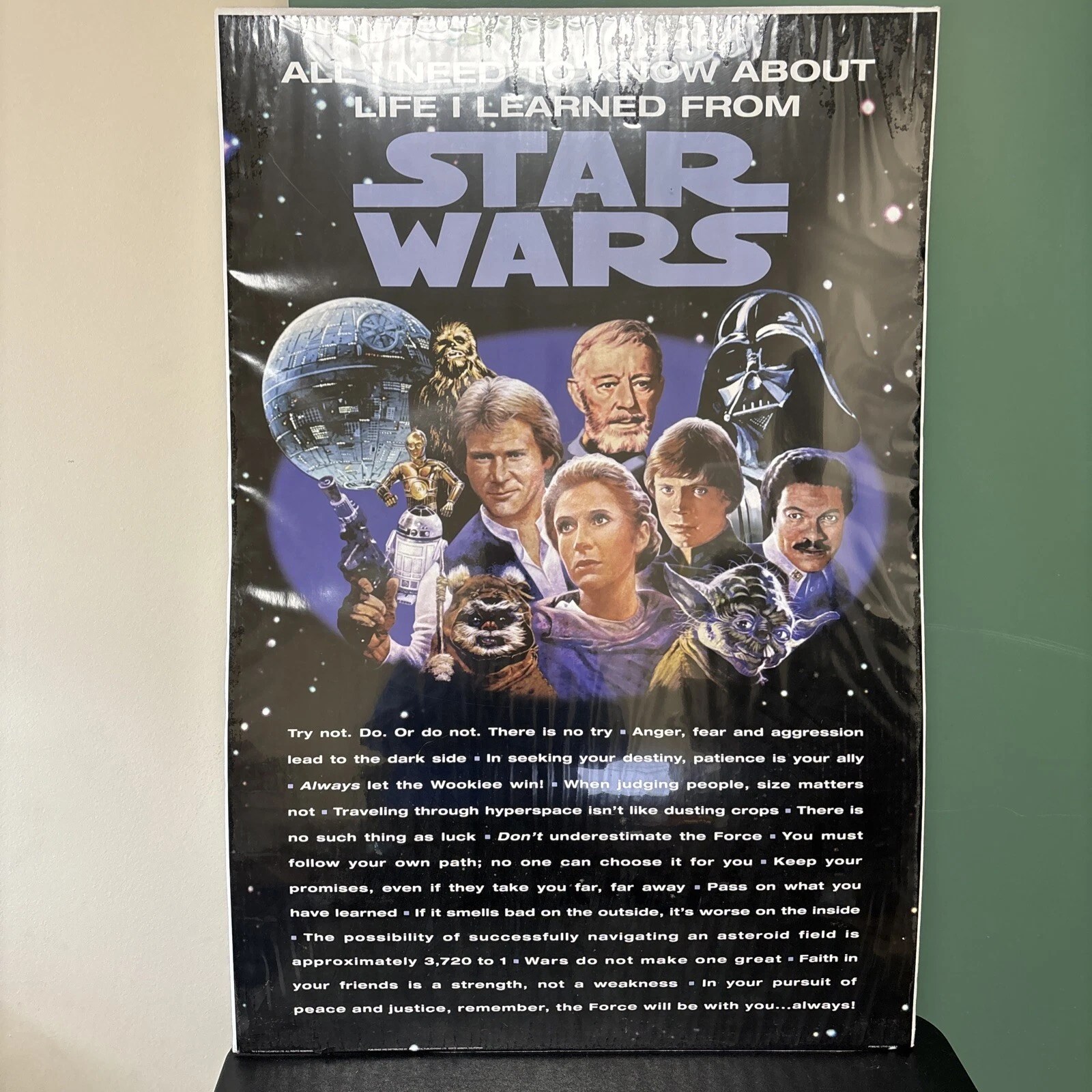
It reminds me of a silly poster I had in my room as a kid, “All you need to learn about life I learned from Star Wars.” But really, I think it would have been better if it said from DMing Dungeons and Dragons.

Image from Ebay.

I was always socially anxious, but overtime running games helped me learn to improvise and trust my gut. This helped with confidence in all aspects of life. I think you’ll find it gets easier overtime, and that you require less and less preparation to feel confident. It’s also super rewarding to see how much many players appreciate the effort.

So, prep loosely or whatever. But really, prep enough to make yourself *feel* ready, whatever that amount is.

Scabard Product Review.

Scabard RPG Campaign Manager

Rating:

19, Near Crit!

Pros

  • Simple to use wiki format.
  • Easy to share with players, and keep secrets hidden.
  • Proper Noun Detector automatically links pages. Aiding world development.
  • Rich set of connections to define and track relationships.
  • Affordable plans ranging from free to $19.95/month.
  • Very responsive developer seeks community feedback and quickly addresses issues.

Cons

  • Many key features are pay-walled, and most new features are in the most expensive plan.
  • Proper Noun Detector could use auto-complete (does have an ex-post AKA/alias option for linking).
  • Could use a non-GM comment capability to allow players to comment on pages too. Although, there are some features to allow players to add to the campaign.

I’ve wanted to start product reviews for a while, and I have a few more in mind. I’m going to start with some of my favorite resources for DMing. I’d love to see these products supported so they continue. This page does not contain any affiliate links.

Why Scabard?

Scabard helps me with my biggest problem as a DM, keeping details and campaign notes well organized.

This is especially true for long-running campaigns, and often the problem is exacerbated by intermittent breaks. Over the years I’ve tried numerous strategies for this. I have a closet full of binders with notes from past campaigns, countless OneNote and Word documents, custom software like RealmWorks (now deprecated), and multiple tools to store hand-written notes (RocketBook and a Kindle Scribe).

A small fraction of my notebooks, along with my RocketBook and Kindle Scribe

While I will never move away from using other tools for ideation and informal notes, Scabard is my go to campaign manager. Check out the campaign I’ve been playing for the last year, Bishou. More about it later.

Glancing through pages, you can see I have added many types of resources. Maps, images, notes, and more. I even create blank placeholder pages as well, often minor NPCs like this one. Sometimes, the blank pages contain secrets I haven’t yet shared with my players, other times they are reminders for me to write more later. After each gaming session, I publish a summary that I review those before sessions.

There are two features that make me keep returning to this tool time and time again. First, the simple wiki-style layout that can be shared directly with the players. Second, the Proper Noun Detector with Auto-Linking.

These two features provide the core functionality that I use most frequently. There isn’t a lot to say about the wiki-style layout.

Overall, the platform provides a simple page-layout and categories you can assign each page to. This places the pages within groups and provides some simple linking capabilities across the pages. These links appear on the right-hand side of the page. They can also be hidden by the Campaign Owner if you need to keep them a secret.

You can also click a simple check-box on any page to hide the entire page from the players.

What’s so cool about Noun Detection?

I firmly buy into the type of world building where you spin outwards from a starting point. The proper noun detector is a dangerous rabbit hole for me. It helps you quickly create pages for every proper noun it detects and automatically links to those you already have. It tries to identify similarly named pages and provides an option to use them as an alias. Aliases function as a list of names that will also link to that page.

My one critique is that I wish it was easier to reduce the list of nouns it detects and help with spelling errors. This may be an issue for me because I use google translate to create hard to remember names.

What would make this tool better?

Overtime, I have had to upgrade my subscription just to keep all my older campaigns. I don’t mind because I love supporting the tools development but the next tier is $19.95/month (or 25% off if purchased annually), and that is pricey.

I’d love a way for players to comment on pages. In my current campaign, my players often link or quote things in our discord server. It would be great if they could do this directly on the blog without being added as a GM.

Finally, I’d love an auto-complete option for the proper noun detector. Although, if I had it I would complain it’s always trying to change words like it does on my phone! That complaint is certainly nitpicky.

What haven’t I tried?

I subscribe to their legend tier, because I have years of campaigns saved on the tool and keep adding more. But, this means I haven’t tried many of the enhanced AI features. I’ll eventually write a post on my opinions of AI, so I’ll leave that for another discussion. Still, there are a lot of features in the Mythic tier that seem like they could be super useful. I find the tool more than sufficient at the lower tiers.

Power Players. This might solve my player comment problem. But it gives slightly more control to players than I’m looking for, and I find it difficult to get players to take actions outside of the game.

Siren Encounters

I missed writing a summary of the session where the heroes faced the sirens I described here. I tend to over prep, largely because I love world-building. Instead of a narrative description of what happened, I thought I’d share my notes with some commentary. My notes throughout this article are italicized. I left them exactly as they were written, just to see how rough things start out.

This adventure was inspired by an idea i had for the opening scene. My adventure kicked off with the following:

You find yourselves gathered on the beach looking inwards to the island as the Kahuna’s beckon Princess Anahera to the makeshift altar they assembled.  You hear the gentle song of the wind through palm fronds, smell the salty ocean breeze, see the sun setting over the palm trees behind the princess.

The Kahunas, Akamai and Kalahari, move up to the stage as a gentle lulling song begins. It’s sound a perfect match to the melodies of nature. Many of those watching the ceremony rise to sway to the rhythm of the music. Then, the crowd begins to disperse.

The two Kahunas look out on the crowd with shocked expressions, and chaos erupts. Kalahari dives for a drum and begins vigorously pounding a chaotic counter-rhythm. Not a single beat of his rhythm aligned to the captivating song coming from the sea. Combined the music is almost painful to listen too. Many of those previously captivated by the song, now appear confused or in pain.

Simultaneously, Kahuna Akamai tackles the princess, covers her ears, and begins screaming for people to run to the woods. But, alas for some the Kahuna’s actions came too late.

 A crowd of people compelled by the gentle music coming from the sea walk into the ocean. Some are swept away by the current, others run to those walking heedlessly into the waves attempting to pull them back. A few manage to drag their loved ones back to shore against their will, while others are pulled away with those they intended to save. Almost as surreptitiously as the song began, it stops. The sun, now below the horizon. The spirit of the day crushed.

Amidst the chaos, what do you do?

The monologue was longer than I like, but I wanted to set the overall tone of the scene. Plus, I sometimes do these things as writing exercises that also help with character development for the NPCs.

I also had notes for actions the PCs could take during the scene:

During the Scene. What can the players do.

They can role exert or survive (str or dex) to run down and drag people back. As they do, be sure to reward high rolls describing people they’ve managed to save.

If they immediately take a small craft out, they can roll Survive/Notice Wisdom to try to figure out where the sound came from. A high roll will lead to a quick combat encounter with 1 or 2 sirens depending on the group size.

If I recall, the heroes ran inland. My next section of notes was a summary. I decided I wanted to add some more friction to the slow burn romance between Anahera and Tepiti. So, I tied in a miss from an earlier session where no one had done anything about the Tahitians allying with the Sirens.

“I am sure it is no mystery why we have called you hear today. ”Prince Tepiti takes a moment to look each of you in the eyes, then turns towards Anahera and bows his head in shame.“ My Princess, I have failed you here. But, I’ve found our bravest adventurers to help us once again secure our island. We,” The prince gestures broadly to the princess and the two Kahuna’s present, ”Do not know exactly what happened, and are hoping you all can help us figure out what’s occurred and prevent it from happening again.”

What can they learn before setting out.

  • The Kahuna’s will each share info of what could be learned on their respective islands.
    • Kalahari. Tahitians have had many past run-ins with Sirens, they may perhaps know where the Sirens were from.
    • Tepiti will note that some discussion of Sirens was made in the war councils before Parau-tia was killed.
    • Akamai. Will be immediately suspicious of the Patongans who attempted to kill Anahera.
    • Anahera. Will mention her brother and suggest that he of anyone would know how a voice could be amplified so effectively.
    • Others on the island?
      • A fisherman from Tahitia will share a technique to create an ear plug from tree resin.

This list is a lot more representative of my usual prep. My Polynesian adventures are story heavy, so I write a lot of narrative scripts. I don’t usually read these aloud when they are this long. But, writing them out helps me think about how the characters react in different situations.

The rest of my adventure outline was a series of bullet points. Outlining potential courses of action.

For this adventure, I used time pressure to build some tension. I placed three leads on the island, far more than they could follow. I designed them so easy it would be easy to follow-up on one, hard for two, and impossible for three (I put them in a bit of a triangle on the map). The players opted to tackle the two closest objectives.

One other thing worth noting in the adventure outline, is the redundancy. My notes say, “They have three potential ways to find the location of the sirens.” This is an intentional and important part of adventure design. It’s really easy for players to miss hints that may otherwise seem obvious. You’ll find lot’s of advice out there on this, and it’s part of why people say to use red herrings sparingly. While playing, I’ll roll with creative ideas the players come up with, even if it wasn’t the intended solution.

Adventure Outline

The adventure has three key components.

  1. Finding out how the Sirens have amplified their voice (a massive conch shell)
  2. Finding the location of the Sirens
  3. Figuring out how to deal with the sirens

Additionally, the PCs are given a variety of choices along the way. These choices provide advantages for various ways to deal with the Sirens.

  1. They have three potential ways to find the location of the sirens:
    1. Sailing to Tahitia to follow up on rumors they hear from former Tahitians who have fallen prey to Sirens in the past. This is a common fear from Tahitians. The Kahuna from Tahitia will hint at this in the intro.
    1. Sailing to Anahera’s former enemies the Patongans, assuming they’ve somehow allied with the Sirens. (An ironic error of judgement by Anahera and Tepiti, but even Tepiti is unaware of the level of corruption Kahuna Parua-tia had bestowed upon his father).
    1. Searching for the SIrens themselves, with the help of Hina or Tahwhiri. Provide some advantage to PCs who quickly move to chasing down the Sirens in the opening scene.
  2.  How they deal with the Siren threat.
    1. Force. Destroying the conch shell and killing many sirens.
    1. Subterfuge. Stealing the conch shell and using it to protect the island from their song.
    1. Negotiation. Striking a deal with the sirens, and helping them once again learn a new song from the gods.

A key issue in this adventure is timing. The timeline for the following events is such that the PCs should be able to sail three times (visit two of the three islands and return) before the situation escalates untenably. One of the Kahuna’s will send a message on the winds to the PCs after the second attack warning of an escalating situation. This may incentivize the PCS to use speed while traveling, but risk some encounters at sea.

Tahitia.

Asking around the island, you’ll hear rumors of fisherman who’ve heard singing at dawn and dusk while fishing. While this isn’t totally unheard of, it’s grown stronger recently and Tama Waiariki’s canoe was recently found empty in the reefs.

Additionally, some rumors that Parau Tia had Haikili attempt to recruit the Sirens for their war efforts. If confronted, Haikili will at first lie. A connect or convince check could persuade him to give information. Increase difficulty by 1 if intimidation is used. Playing on his guilt for participating in this should help the PCS

  • The PCs can encounter the Sirens by stalking the common fishing areas at Dawn/Dusk
  • From here they could kill, capture, or attempt to track the Sirens to a cave
  • The PCs can learn the Sirens were paid with a shell from the Island of Little Giants

Pakonga

If any of the islanders are from Moanatu (Anahera’s home island), the chance of escalating to conflict is higher. What happens on this island depends a lot on how the PCs approach. If things go badly, the Pakongans will try to assault the new island in a future adventure.

  • Entering the island.
    • Disquise. The PCs may attempt to disguise themselves as performers or traders to gain audience. Make this a relatively easy check.
    • Subterfuge. May allow PCs to sneak on.
    • Diplomacy. This will be the hardest approach, particularly if the PCs say they hail from Moanatu. Some sort of offering of strength would help this.
  • Chief Aoraki (Oh-raki):
    • If the PCS are brought to him while captured. Perhaps we shall make sport of you, if you win we shall let you leave.
    • If the PCs persuade their way to an audience.
      • We are a proud tribe and need no monstrous allies to fight our battles.
      • Will share the legend of the Sirens. They are not to be trusted.
        • There is an area of caves between X/Y that you may search if you seek them out.
      • Kahuna may share that this seems on par for what Parau-Tia would have done, perhaps the Tahitians had planned to use them. He was desperate and had come to us once asking for an allegiance.

Moanatu

The key thing that could be learned and/or acquired here is the advice of Prince Teva. He will hypothesize that a massive shell could be used to amplify the voices of the Sirens making them especially dangerous.

  • He will help the PCs to devise protective ear coverings allowing them to re-roll all failed saves against Siren Songs once.
  • He will help devise a tool likely effective at destroying the shell.

In one-shots, I always hand-out one time use magic items.  In this adventure, these proved to be super pivotal. By far the most memorable scene was when the PCs finally found the Sirens. One of the PCs used a potion of disguise to change into a Siren. Then then convinced the Sirens he had befriended the people to eat them later.

In the final battle, the rest of the items got used. The PCs ended smashing the conch shell, and returned to the island after ending the Siren threat.

Song of the Sirens

Recently my focus has been on revisions for two upcoming publications, Mysteries in Elanysia and Echoes of the Void. For the first one, I have some commissioned art now and I AM EXCITED! This has put work on my Polynesian game Journey of the Wayfinder on the back-burner.

For my next one-shot, Song of the Sirens, I went deep on original lore for the main enemy. The lore came from trying to answer a simple question, “If the PCs wanted to strike a bargain with the Sirens what would they need to provide?” The answer came quickly, a new song from the gods. This led me to ask, why?

That why became a myth. It’s inspiration is as much Greek tragedy as it is Polynesian. After all I’ve been reading Greek myths since I was a kid. Hopefully I’ve managed to capture a bit of the spirit of Polynesian Myths as well. The legend follows below:

              There was once a beautiful Arioi named Moatangi, whose performances were a mesmerizing array of dancing on water and singing. She’d climb the mast of her canoe, belt songs swinging from the ropes, dive into the sea, and swim back continuing her song until she emerged from the water to finish her ballad as she walked ashore. Over time these acts grew in grandeur. Sometimes she involved dozens of vessels in the act. Lower ranked Arioi would swim in unison, and a chorus of singers, dancers, and musicians accompanied her.

              Her performances eventually attracted the attention of Tavahanu, voice of the wind. At first, he listened silently. The stillness of the wind while he listened provided a quiet backdrop which emphasized the grandeur of her performance. Then, Tavahanu began to carry Moatangi’s songs farther, emboldening the fortes and muting the pianos. Over time, she replaced some of her accompaniment with the sounds of nature. Learning, if only subconsciously, how to leverage the songs of nature. As she sang, the wind would carry the melody of birds, the song of palm fronds swaying in the winds, or the violent echoes of the wind wailing through hollow passages.

              One night as she slept under the stars on the beach, she awoke to a whistling sound leading inland. Thinking she heard the echo of her name on the wind, she followed the sound. Eventually, she found its source to be a cave and heard the most beautiful array of nature’s melodies ever.

The cave was the perfect instrument for the wind. A thousand hollowed out caverns of different shapes and sizes allowing the wind to create a symphony of noises, replicating any sound imaginable. Tavahanu filled the cave with music and Moatangi began to sing a melody to the tune. Her song was a love ballad, like the world had never heard. Starting with the eternal embrace of Rangi and Papa, telling of the one-sided love of Hina and Tuna, the near tragedy of Hinemoa and Tūtānekai, and continuing with all the love stories of the gods.

              Throughout the night islanders were stirred awake by the music. They were mesmerized by the sounds and found themselves compelled to move towards the music. Enraptured by the music everyone who came stayed the entire night. Moatangi never looked outside the cave. She was overcome by the feelings she attempted to express through the ballad she sang. Having finally found the melody within her soul.

              As the sun began to rise the Arioi’s voice broke. Her music stopped, and finally she whispered. “What are you to make such beautiful songs, I have seen nothing all night as I accompanied you? My voice but a back-up singer to the melody of love itself.”

              The wind replied, “Moatangi, you are mistaken. The tune comes from your heart, I but listen and play it so you can sing. I am Tavahanu, voice of the wind. Stay here with me for nowhere else can I come close to echoing the beauty of your voice. No where else can I make all sounds that can be heard by man. Long I have tried to lead you here.”

               She paused for a long moment, puzzled by the statement. For nothing has freedom like the wind. Blowing over land and sea, touching both the heavens and the earth. Finally, she replied, “Anywhere can the wind move, why can you not make these sounds elsewhere?”

              Tavahanu explained that although he can move anywhere the wind can, the wind has no voice of its own. The wind plays nature like the Arioi play their instruments. Tavahanu replied, “The whole world is my instrument, but nowhere else can I play such a symphony in one place.”

              As the two conversed, the magic of the music faded. The compulsion over those watching faded, and the crowd began to murmur and ask questions. Only then did Moatangi notice the audience. For her also the compulsion began to fade, and her own wits began to return. Realizing how long she sang, wondering how long people had listened, she considered what singing with Tavahanu could achieve. She glanced down at her painted leg, a symbol of her reaching the pinnacle of status among the Arioi. Realizing singing with a god, could make the black leg seem pale in comparison.

              She considered the winds response and finally responded herself. “Could you not use me?”        

              In this part, the legends vary. Some say the wind filled her lungs. Others say she would wear ostentatious outfits of shells so the wind could make a symphony of sounds. Most say the wind made love to her, using her to make the sounds. Regardless of the truth, the pair traveled together from island to island putting on legendary performances. Captivating all who listened, even playing for and captivating the gods. The stories also agree that eventually, she carried a child.

              Unfortunately, while Tavahanu could father a child. He could not be a child’s father. For a while, the performances stopped as the Arioi cared for the newborn. But the wind kept blowing. Sometimes visiting, but being carried away for longer and longer periods of time.

However, Moatangi had learned many of the wind’s secrets while they had sung together. One day when Moatangi needed help, she sung a song into the wind like that day at the cave. She used its tune to compel someone’s attention, and continued to refine it until she compelled them to help her.

               Moatangi continued to master this skill, compelling others to do her bidding. It started with small favors. Preparing food, launching her boat, caring for her child while she swam. But overtime she would push the limits. She began to compel people to follow her, to rule their minds completely. Sometimes the wind returned, but most times it simply passed through.

              Still during this time her fame and renown had grown so much that gods commonly frequented her performances. But she longed for Tavahanu. She began to test her compulsion on the gods themselves. Small things at first, hoping to compel the wind to stay. With the wind, while she could keep its attention, it would never stop blowing for long. Even though Tavahanu loved her he simply couldn’t stay.

              One day, she was performing on an island far in the west. At the source of Mātāhiti Apatoa (the east wind). She realized if she could capture this wind, she could keep Tavahanu with her. She put on her most brilliant performance yet, and captivated Tahwhiri’s children. Eventually,  Tahwhiri god of storms and winds, realized his children were missing. Asking the other gods he learned of Moatangi. He requested the help of Tangoroa, knowing he needed to send Moatangi into the depths that he and his offspring could not reach.

              Together, Tahwhiri and Tangaora approached the island in a hurricane of destruction. Tahwhiri appeared before Moatangi and said, “Never shall you set shore upon the lands of man again, forever shall you be bound to sea. Where Tavahanu cannot go.”

              Then Moatangi flopped over, splashing into the water. She attempted to stand but found her legs had merged, and her bottom half looked like a fish. Confused and frightened she flopped about in the water. Her appearance had become deformed and hidous. After that, whenever she found a new audience, they ran from her in fear. The only way she could keep an audience, was to compel them.  

So, whenever she sees men, she sings her song and drags them into the sea with her. All the while craving the attention of Tavahanu, who could not come with her. She swam from island to island, looking for caves, hoping to find Tavahanu once again.

              With Moatangi beneath the sea, Tavahanu howls across the sea singing a sad song of mourning searching for her. To this day, he still does. Moatangi’s children can often be found, singing their compelling songs and luring men to the depths with them. Usually near caves, where they find a strange appeal to the howling of the wind through the caverns.

              This is how Sirens came to be, and why they sing their songs to lure men to their deaths. Creating a captive audience in remembrance of audiences they never knew.

Upcoming One-Shots

I’ll be hosting a series of one-shots, starting with three events at the Midwinter Gaming Convention on the 9th and 10th of January.

I’ll be submitting games for additional events, and will share details on those events in this post.

Midwinter Gaming Events:
I’ll be using Stars/Worlds Without Number deluxe rules for all the games below. The Journey to Hawaiki games will include pieces of the Ancient Polynesian rule set I’ve started building.

Journey to Hawaiki-1 and Journey to Hawaiki-2:

Embark on an episodic campaign in the mystical world of Ancient Polynesia.

The gods are meddling in human affairs, each god searching for a heroes to champion their cause. They aim to reclaim the sacred Hawaiki (the mythical homeland to all Polynesians) and need the mightiest champions to undertake this perilous journey. Heroes from various islands are pitted against one another in divine contests, as the gods seek their hero. Every one-shot changes and develops the world for this setting.

Each adventure will start with the chief of your island assigning you an urgent mission. Most involve a balance of roleplaying, combat, and puzzle-esque game opportunities.

Echoes of the Void:

This is a snippet from a longer sci-fi campaign I’ve been writing. The heroes are given a mission by a brilliant widow whose husband disappeared on a work assignment. In classic soap opera style, the heroes will quickly find themselves irreversibly involved in a larger set of problems. It features classic sci-fi action (space combat), some sci-fi horror, and a little science fiction esque magic.